Key takeaways
- Wrinkles can develop due to a combination of factors, including natural ageing, sun exposure, and repeated facial movements, rather than a single cause.
- Changes in collagen and skin elasticity may contribute to wrinkle formation over time, which can affect how the skin looks and responds to movement.
- Wrinkle treatments may help reduce the appearance of certain lines, depending on the approach used and individual suitability, which is typically determined through consultation.
You don’t usually notice wrinkles forming.
It’s more that one day, something looks different. A line catches the light. Your makeup sits slightly unevenly. And you start wondering if it’s new — or if it’s been there longer than you realised.
Because that’s the thing. Wrinkles rarely appear all at once.
They build slowly because of a mix of changes happening under the surface, plus everything your skin’s been exposed to over time.
Age is part of it. But it’s not the full story.
What are wrinkles, really?
If you strip it right back, a wrinkle is what happens when skin stops bouncing back the way it used to.
That “bounce” depends on structure. Collagen, elastin, hydration — all working together. When those are stable, skin tends to look smooth. When they start to shift, things change.
You’ll usually see fine lines first. They’re inconsistent. Some days they’re there, other days they’re not. Often worse when you’re tired, dehydrated, or just noticing your skin more.
Deeper lines behave differently. They don’t come and go. They stay.
So what’s actually driving that?
Part of it is mechanical. Your face moves constantly… talking, smiling, frowning without thinking about it. Those movements create folds in the skin.
When the skin still has strong support underneath, those folds flatten out again. No trace left behind.
But once that support weakens, even slightly, the skin doesn’t rebound the same way. The crease lingers. Then it settles.
That’s usually the turning point.
And it’s why wrinkles don’t come from one single cause. It’s layers of change happening at once.
What causes wrinkles: the natural ageing process
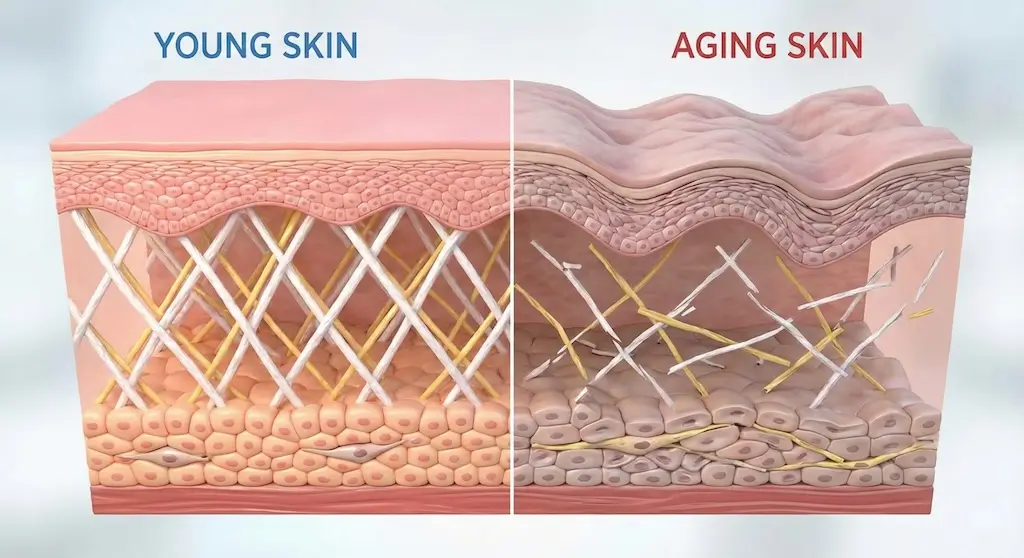
Ageing gets blamed for wrinkles, but it’s not just about time passing.
It’s about what your skin is no longer doing as efficiently as it once did.
From your mid-20s, collagen production begins to slow. Not dramatically. You won’t notice it straight away, but it’s happening in the background.
Over the years, that gradual shift adds up.
Collagen and elastin decline
Collagen gives skin its structure. Elastin gives it flexibility.
As both reduce, the skin becomes less resilient. It doesn’t hold shape the same way. It doesn’t recover as quickly after movement.
You won’t necessarily feel this happening. But you’ll start to see it.
Slower skin renewal
Skin is constantly turning over with new cells replacing old ones.
That process slows with age. So older cells sit on the surface longer. Texture can feel rougher. Fine lines can look more defined, even if nothing dramatic has changed underneath.
Facial volume changes
Then there’s the part people don’t always expect.
Ageing affects what’s under the skin too. Fat pads shift. Some areas lose volume. Bone structure subtly changes.
That loss of support changes how the skin sits. Which is why certain areas — around the mouth, cheeks, jawline — start to fold differently.
Environmental factors that accelerate wrinkles
Wrinkles aren’t just about what’s happening internally. They’re also shaped by what your skin is exposed to repeatedly and over time.
And some of these factors matter more than people realise.
- Sun exposure (photoageing) – UV radiation doesn’t just affect the surface. It breaks down collagen over time. And once that support starts to weaken, wrinkles tend to follow. That’s why areas that get the most sun, like the face, neck, and hands, often show changes earlier.
- Smoking and pollution – Things like pollution, smoking, and general toxin exposure can interfere with how skin repairs itself. It’s not always obvious in the short term. But over time, it adds up.
- Repetitive facial movements – You raise your eyebrows. You squint. You smile. Thousands of times, every week. At first, those lines disappear straight away. But eventually, some of them don’t. That’s where expression lines come from. Not suddenly — just repeatedly.
Lifestyle and skin habits that influence wrinkles
This is the part people tend to underestimate.
Because lifestyle doesn’t usually cause wrinkles outright. But it can absolutely influence how your skin handles everything else.
- Skincare and hydration – Hydrated skin generally looks smoother. That’s not surprising. Fine lines can soften when the skin barrier is supported. But it’s often temporary. Once deeper structural changes are there, skincare has its limits.
- Sleep and stress – A lot of skin repair happens overnight. So when sleep is inconsistent, that process doesn’t run as well. Over time, that can show up in subtle ways, including how lines sit on the skin. Stress plays into this too. Not instantly, but cumulatively.
- Nutrition and skin health – Nutrients support how skin functions, repairs, and maintains itself. But it’s not a quick fix. More like a long-term influence that works alongside everything else.
Can wrinkles be prevented or reduced?
This is usually the real question.
And the honest answer is — not completely. Wrinkles are part of how skin changes. That’s unavoidable.
But how they develop, how quickly they show, and how noticeable they become is usually more flexible.
Prevention is about slowing things down. Reducing sun exposure. Supporting the skin barrier. Limiting repeated damage where possible.
On the other hand, corrections are a bit different. Once a wrinkle becomes more fixed, skincare alone usually won’t shift it much. That’s when other options might be considered.
Possible treatment pathways
Different wrinkle treatments in Melbourne work in different ways.
Some target muscle movement, particularly for expression lines. Others focus more on the skin itself, aiming to support hydration or overall quality.
It depends on what’s actually causing the wrinkle in the first place.
And in most cases, it’s not about removing every line. It’s about how noticeable they are and how the skin behaves overall.
Also, remember that there’s no universal timeline for wrinkle treatments.
Some people notice changes earlier. Others much later.
Even the type of wrinkle matters. Not all lines respond the same way. Which is why treatment decisions tend to be individual, not formula-based.
How Luxe Lips approaches wrinkle treatments
At Luxe Lips, a cosmetic clinic in Melbourne, our care is grounded in medical ethics and clinical responsibility. Wrinkle treatments are approached as a medical process, with patient safety and appropriate care guiding each step.
Across our clinics in Camberwell, Moonee Ponds, and Brighton, every person undergoes a thorough consultation before any treatment is considered. This includes reviewing medical history, assessing facial anatomy, and understanding your individual concerns.
Practitioners proceed only when a treatment is clinically appropriate. If wrinkle treatment does not align with your anatomy or health profile, this will be clearly explained, along with alternative considerations where relevant.
Because wrinkle formation varies from person to person, there is no universal approach. Booking a consultation allows for an informed discussion about what may or may not be suitable in your case.
Note: Individual responses vary. A consultation with a qualified professional is required to determine the suitability of any treatment for your specific needs.
Frequently asked questions about what causes wrinkles
Wrinkles can appear suddenly, but they usually form gradually beneath the skin before becoming visible. As collagen and elastin decline, the skin loses support, and lines that were previously temporary can start to remain. Changes in hydration, lighting, or skin quality can make them seem more noticeable from one day to the next.
Wrinkles are lines, creases, or folds in the skin that develop when its structural support decreases. This typically happens as collagen, elastin, and hydration levels decline over time. They may begin as fine lines and deepen depending on ageing, sun exposure, and repeated facial movement.
Under-eye wrinkles are primarily caused by a combination of thin skin, collagen loss, and repeated movement. The skin in this area is more delicate, which makes it more vulnerable to dehydration and early structural changes. Sun exposure and habits like squinting can further accelerate their development.
Forehead wrinkles are mainly caused by repeated muscle movement, particularly raising the eyebrows. Over time, these movements create lines that can become fixed as collagen and elastin decline. Sun exposure and skin ageing can make these lines more pronounced.
Wrinkles on the face are caused by a combination of intrinsic ageing and external factors. Collagen loss, reduced elasticity, sun exposure, and repeated facial expressions all contribute. Lifestyle factors such as smoking, stress, and skincare habits can also influence how quickly they develop.
Wrinkles are not only caused by ageing, although it is a primary factor. External influences such as sun exposure, smoking, and environmental stress can accelerate collagen breakdown. As a result, wrinkles may appear earlier or become more noticeable depending on these factors.
Wrinkles cannot be completely prevented, but their formation can often be slowed. Consistent sun protection, supportive skincare, and healthy lifestyle habits may help reduce the rate at which they develop. The extent of prevention varies depending on individual skin and environmental exposure.
Wrinkle treatments are non-surgical procedures designed to reduce the appearance of lines and support the skin’s structure. They typically work in different ways — some relax the facial muscles that contribute to expression lines, while others focus on improving skin quality, hydration, or collagen activity. The most suitable approach depends on the type of wrinkle, its cause, and individual skin characteristics, so a professional assessment is usually required.