*Updated March 2026*
Facial harmony refers to how well your features work together.
It comes down to balance, proportion, and how each feature fits within your overall structure.
When these elements align, the face tends to appear more balanced and naturally proportioned.
As time passes, changes in volume and structure may shift that balance.
Different face shapes often show these changes in different ways.
Understanding your own structure is the first step before considering any treatment options.
Key Takeaways
- Facial harmony refers to how your features relate to each other in terms of balance, proportion, and overall structure. Rather than focusing on one feature in isolation, it considers how the face works as a whole and how subtle differences can influence overall appearance.
- Facial balance may shift over time due to changes in volume, skin quality, and underlying structure. These changes can affect how features sit in relation to each other, which may alter overall harmony depending on your natural face shape.
- In line with Australian medical standards, a professional consultation is required before considering any treatment options. This assessment focuses on your individual facial structure, medical history, and goals to determine what may be suitable for you.
What Is Facial Harmony?
Facial harmony describes how each feature aligns within the overall structure of the face.
It focuses on how the eyes, nose, lips, and jaw relate to each other, rather than how any single feature appears in isolation.
In clinical settings, this is assessed by looking at proportions across different areas of the face.
Common reference points include the upper, middle, and lower thirds, along with the width and projection of key features.
Differences between these areas can influence how balanced the face appears.
For example, variations in the lower face or changes in mid-face volume can affect how other features are perceived.
Facial harmony is not about making features identical or symmetrical.
It refers to how features sit together in a way that aligns with your natural structure.
Because every face is different, what appears balanced for one person may not apply to another.
Why facial harmony changes with age
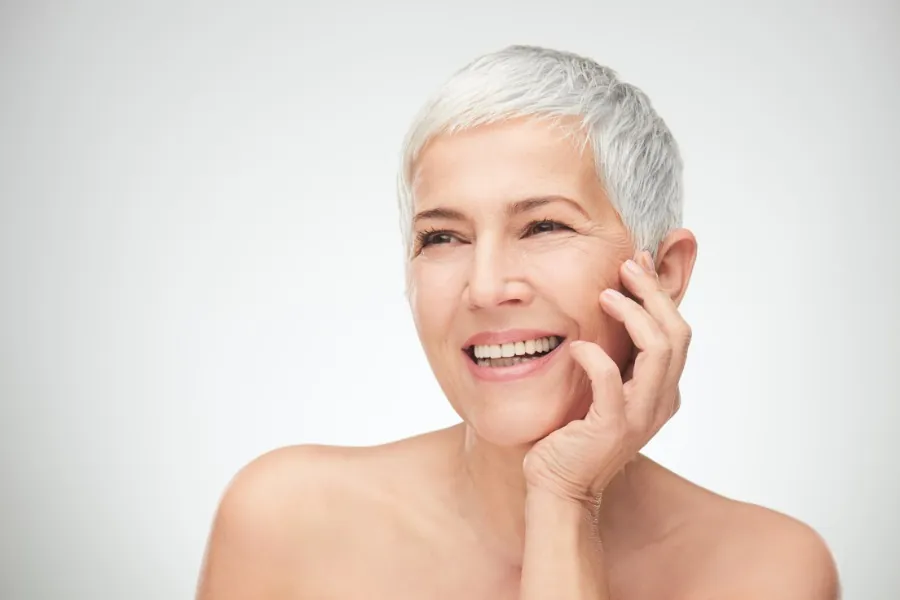
When we’re younger, the widest part of the face is typically the cheeks, with a tapering toward the chin, often referred to as the “triangle of youth.” At this stage, features tend to appear more lifted, with fuller cheeks and a more defined jawline.
Over time, natural changes in skin and underlying structures can alter this shape. Volume in the mid-face may decrease, while the lower face, particularly the jawline, can appear broader or less defined. This shift is commonly described as the “pyramid of age.”
Significant weight loss can drive the same kind of change on a faster timeline, and the face after weight loss often shows volume shifts across the cheeks, temples, and jawline.
Lifestyle factors such as nutrition, sleep, and skincare play a role in how these changes develop. Some individuals choose to explore cosmetic aesthetic treatments as part of managing these structural changes.
Why This Matters in Aesthetic Planning
Taking a full-face approach may help support a refreshed and proportionate appearance. For example, changes to the mid-face might affect how the chin or jawline is perceived. That’s why many aesthetic consultations begin with a comprehensive facial assessment. Not just to identify areas of change, but to create a tailored plan based on your unique structure.

Researchers have explored the concept of facial symmetry through the lens of evolutionary psychology. The Evolutionary Advantage theory suggests that people may subconsciously perceive symmetrical features as a sign of genetic fitness or developmental stability. In some studies, facial symmetry has been loosely associated with perceptions of attractiveness, which may influence social interactions.
Beyond this, several scholars have examined how attractiveness , as socially defined, can influence aspects of personal or professional life. These studies don’t establish causation but highlight how societal perceptions can shape individual experiences.
Confidence and Self-Esteem

Some studies in social psychology have explored how perceived attractiveness can influence interpersonal dynamics. For instance, certain research has observed that individuals considered more attractive may be perceived as more assertive or confident in communication settings. Other studies suggest that social reinforcement, such as receiving more positive attention or praise, may contribute to higher self-esteem in some individuals.
It’s important to remember that these are general observations from population-level data and do not determine individual worth, personality, or capabilities. Everyone’s experience is unique, and true confidence comes from feeling comfortable in your own skin, whatever that may look like.
Professional success

Some studies have examined the role of perceived facial attractiveness in professional settings. For instance, certain research has observed that individuals rated higher on facial attractiveness scales may receive more favourable evaluations during job screenings. A separate study from the University of Wisconsin explored correlations between CEO facial ratings and company performance, noting an association between higher facial attractiveness scores and stock returns.
It’s important to interpret such findings with nuance. These observations reflect broader societal perceptions and do not determine a person’s worth, skills, or success. Cosmetic aesthetics should never be positioned as a shortcut to professional achievement, but rather as one of many personal choices made for self-confidence, comfort, or wellbeing.
How facial harmony is improved without surgery
As we age, it’s natural for the face to lose volume, definition, and skin elasticity. Cosmetic aesthetic treatments can offer personalised options that support your natural features and address common concerns related to facial structure and skin quality.
Volume Support and Facial Contouring
Certain treatments, including lip enhancement and facial contouring treatments, can help restore facial volume and soften the appearance of fine lines by using gel-like substances that sit beneath the skin. These substances are carefully placed by trained health professionals to support contours and structure.
Depending on the area of concern and the material used, these treatments may:
- Add fullness to lips and cheeks
- Support facial proportions and structure
- Soften the appearance of lines or folds
- Help reduce the appearance of scars or uneven texture
Wrinkle-reducing treatments
Wrinkle treatments are another commonly used option, involving small doses of muscle-relaxing medications that temporarily reduce specific facial movements. When performed by a qualified provider, this may help soften the appearance of:
- Frown lines between the brows
- Horizontal lines on the forehead
- Lines around the eye area
These treatments work by relaxing the underlying muscles, which may reduce the appearance of expressive lines over time.
How practitioners assess facial harmony
Practitioners assess facial harmony by looking at how different areas of the face relate to each other in terms of proportion, balance, and structure.
One common method involves dividing the face into horizontal sections known as the facial thirds. These include the upper, middle, and lower portions of the face. Ideally, these areas sit in balanced proportion, although natural variation is expected.
Vertical proportions are also considered. This includes the width of features such as the eyes, nose, and mouth, and how they align across the face.
In some cases, practitioners may refer to a facial harmony score as a way to guide assessment. This is not a fixed number, but rather a general framework used to evaluate how features sit together.
Skin quality, volume distribution, and structural support are also reviewed during consultation. These factors can influence how proportions appear and how facial harmony changes over time.
Because every face is different, assessments are always based on individual structure rather than a single ideal standard.
Professional standards at Luxe Lips
At Luxe Lips, a cosmetic clinic in Melbourne, the approach to care is grounded in medical ethics and professional responsibility. Every treatment journey is approached as a medical process, focusing on established health protocols and safety.
Our medical professionals in our clinics in Moonee Ponds, Camberwell, and Brighton prioritise a thorough screening conversation for every person, including a review of medical history, anatomical suitability, and psychological readiness. In accordance with local guidelines, this careful assessment helps determine whether a proposed plan is appropriate for the client’s health and circumstances.
Practitioners proceed with a treatment plan only when it is clinically appropriate for the person. If a procedure is not aligned with a client’s health profile or anatomy, the practitioner has a professional responsibility to advise against that pathway. The focus remains on clear, honest communication and maintaining a clinical environment where safety and ethical standards are the priority.
Because individual responses and circumstances vary, booking a consultation is required to determine suitability before any treatment is planned.
Note: Individual responses vary. A consultation with a qualified professional is required to determine the suitability of any treatment for your specific needs.
Common questions about facial harmony
Facial harmony refers to how your features relate to each other in terms of balance, proportion, and overall structure. It considers how the eyes, nose, lips, and jaw align across the face rather than focusing on one feature alone.
Practitioners assess this using frameworks such as facial thirds, symmetry, and proportional relationships. These factors influence how balanced the face appears and how changes over time may affect that balance.
If you want to understand how your facial structure is assessed, a consultation can provide a clearer evaluation.
Perfect facial harmony does not refer to a fixed or universal standard. It is based on general aesthetic principles such as proportion, symmetry, and alignment, which vary between individuals.
In practice, assessments are based on your natural structure rather than an idealised template. What appears balanced for one person may not apply to another due to differences in proportions and facial features.
If you are considering how these principles relate to your own face, a consultation can provide personalised guidance.
Facial harmony is measured using geometric proportions, by dividing the face into three vertical thirds and five horizontal fifths, alongside the 1:1.618 golden ratio.
Medical professionals evaluate structural balance, profile angles, and symmetry to determine what treatments, if any, may be suitable for you.
Non-surgical approaches may be used to support facial proportions and structure, depending on individual assessment. These approaches focus on areas such as volume, muscle activity, and skin quality.
Any treatment decision is based on a professional consultation that considers your anatomy, medical history, and goals. Outcomes vary depending on the individual and the approach used.
If you are exploring options, a consultation can help determine what may be suitable for your situation.
Common contributing factors include ageing, natural asymmetry, and environmental influences such as sun exposure. Over time, these changes can alter proportions across the facial thirds.
If you have noticed changes in your facial structure, a consultation can help assess what may be contributing.