
Acne Scar Revision with Fotona Melbourne
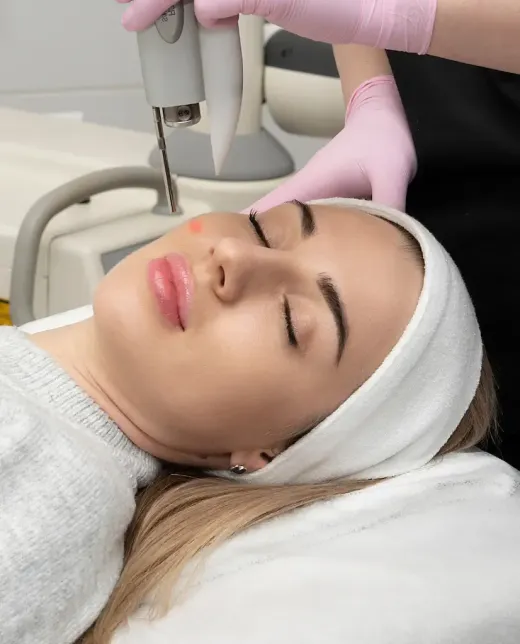
Laser Resurfacing Matched to Each Scar TypeAcne scars form when deep inflammation breaks down collagen faster than the skin can rebuild it, so the surface is pulled down into a depression. Fotona combines two laser wavelengths: Er:YAG works at the surface to resurface and smooth, and Nd:YAG heats deeper to encourage new collagen beneath the scar. The mode and settings are chosen for each scar type, and deeper scars may be paired with radiofrequency microneedling, designed to soften the depression and blend it with the skin around it.
Your AHPRA-registered nurse looks at your skin under angled light, because overhead light flattens shallow depressions, and gently stretches the skin around each scar. Rolling scars soften when stretched, while boxcar and ice-pick scars keep their shape, which shows the scar type before any settings are chosen. Treatment is available at our Moonee Ponds, Brighton and Camberwell clinics.
2,050+
FIVE-STAR REVIEWS
ACROSS ALL MELBOURNE SITES50,000+
TREATMENTS PERFORMED
24/7
Real person chat
3
MELBOURNE CLINICS
Understanding Acne Scarring
Acne scars start in the dermis, the layer beneath the surface where collagen gives skin its strength. When a deep breakout heals, the body often does not produce enough new collagen, and the skin above sinks into a depression. That accounts for most acne scarring. How deep and widespread the damage is depends on:

BREAKOUT DEPTH
deep cysts and nodules damaging more collagen
DURATION
how long inflammation lasted before it cleared
PICKING
pressure that pushes inflammation deeper down
HEALING RESPONSE
how your skin heals and rebuilds after injury
A scar is only fully formed once the breakout has healed, so active acne is usually brought under control first, because treating over live breakouts can spread inflammation and slow healing. Once the skin is stable, the scar type decides which laser mode is used.
Acne Scar Revision by Scar Type
Acne scar revision usually takes three to six sessions, spaced four to six weeks apart, because new collagen keeps forming for weeks after each one. Every Fotona session finishes with SupErficial™ mode, a cold Er:YAG pass across the whole face that vaporises micro-thin layers of dead surface cells as a polishing peel. Most people have more than one scar type, so different areas can be treated with different modes within the same plan.
Rolling scars are wide, shallow depressions with sloping edges that give the skin a wavy, uneven look. They form when fibrous bands develop beneath the skin after deep inflammation, tethering the surface to the tissue below. They show most in side lighting, and they soften when the skin is gently stretched.
Two Nd:YAG modes are used. PIANO® mode delivers a long, gentle pulse that heats the deeper layers in bulk while the surface stays intact, designed to trigger new collagen that may lift the floor of each depression. FRAC3® mode then places a fine grid of heat points in the mid-to-deep dermis, targeting the tethered areas to encourage the skin to remodel.
 How much each scar softens when stretched Scar width and depth under angled lighting Where tethering pulls the surface down the most Skin type and pigment history before heating Whether active acne is still forming new scars
- “Is there downtime?”: PIANO® and FRAC3® work beneath the surface, and the final polishing pass removes only micro-thin layers of dead cells, so redness and warmth usually settle within a day or two, with some fine flaking possible.
- “Why does it feel so warm?” PIANO® heats the deeper layers in bulk, so the skin feels hot during treatment, and cooling is used throughout.
- “My scars are years old. Can they still change?” Older rolling scars can still remodel, though scars that are heavily tethered may soften less.
- “Is it suitable for darker skin?” Nd:YAG passes through surface pigment with less risk of pigment change than surface lasers, and settings are matched to your skin type.
- The depressions may look shallower over time
- Skin may look smoother in angled lighting
- Change tends to build over several months
- Mild redness and warmth after each session
- Heavily tethered scars may respond less to laser
- A recent tan may delay the start of treatment
- Active acne is usually controlled first
- Daily sun protection matters between sessions
- Broad, shallow scars that make skin look wavy
- Scars that soften when the skin is stretched
- Those wanting a shorter recovery period
Boxcar scars are round or oval depressions with steep, upright edges and a flat base, like small craters. They form when inflammation destroys collagen down to a set level, so the edges drop away sharply and don’t slope. Overhead light casts a shadow along those edges, and the scars keep their shape when the skin is stretched.
Two Er:YAG steps are used. Fractional Er:YAG mode uses a technique called tangential ablation, designed to shave down the steep shoulders of each scar and blend the edges into the skin around them. TURBO mode then stacks several pulses on the same spot to create fine channels up to 600 micrometres into the floor of the scar, without overheating the surrounding surface, to encourage healing where the scar dips deepest.
Edge height and how steeply each scar drops Scar diameter and the depth of each floor Skin thickness across the cheeks and temples Skin type and pigment risk before ablation The downtime you can allow around events - “How long is the downtime?” The ablative steps leave a fine grid of pinpoint marks, with redness, crusting or flaking that usually settles over several days.
- “Will the edges disappear?” Softer edges cast less shadow, so each scar may look shallower, though deep boxcar scars rarely disappear completely.
- “Why not resurface the whole face deeply?” Working only on the scar edges and floors leaves the skin between them intact, which shortens healing and lowers pigment risk.
- “Can I wear make-up afterwards?” Mineral make-up is usually fine once the surface has closed over, often after a few days.
- Scar edges may look softer and less defined
- Less shadow may fall across each scar edge
- Several days of redness and fine crusting
- Change tends to build across the full course
- Darker skin types need careful settings
- Downtime is longer than with heat-only modes
- Strict sun protection after each session
- Deep boxcar scars may need combination planning
- Scars with sharp, steep edges and flat bases
- Scars that keep their shape when stretched
- Those able to plan around a few days off
Ice-pick scars are narrow, deep pits, often less than 2 mm across, that run down into the dermis like small punctures. The opening at the surface is tight, the scar widens below it, and dense, rigid collagen lines the upper walls of each pit. They look like enlarged pores up close and keep their shape when the skin is stretched.
Ice-pick scars are treated over alternating appointments. The first deep session often uses Morpheus8, where insulated needles reach into the deeper dermis before releasing radiofrequency heat at the tip, designed to trigger new collagen where each scar begins and support it from the base. Four to six weeks later, FRAC3® mode heats the deeper tissue around the pits to encourage structural repair, and TURBO mode uses a focused beam to break up the rigid collagen lining the top of each pit, which may allow the skin to contract and narrow the opening.
A course usually runs six sessions, alternating three deep sessions with three Fotona sessions.
Width of each opening and how far it runs How many pits there are and where they cluster Skin type and pigment risk before treatment Healing history, including raised scarring Whether other scar types sit alongside them - “Why not just use the laser?” The pits run deeper than the surface modes are designed to reach, so a deeper treatment works at the base while Fotona refines the opening.
- “Do the deep sessions hurt?” Numbing cream is applied first, and you may feel heat and pressure as the needles reach the deeper layer.
- “Why are the appointments spaced out?” Collagen needs four to six weeks to form after each step before the next one is added.
- “Will the pits close completely?” Ice-pick scars may soften and narrow over the course, though some usually remain visible up close.
- Openings may look narrower over the course
- Pits may look shallower as collagen builds
- Pinpoint marks and redness after deep sessions
- Change tends to build across all six visits
- A tendency to raised scars needs assessment
- Very deep pits may respond only in part
- The gaps between visits are part of the plan
- Daily sun protection matters between visits
- Narrow, deep pits that keep their shape
- Scars that look like small puncture marks
- Those able to commit to a six-visit course
Mapping Each Scar Before Settings Are Chosen
Most faces carry a mix of rolling, boxcar and ice-pick scars, often grouped in different areas. Your nurse maps them zone by zone under angled light, so each area is matched to the mode that suits it, and the same zones are photographed again at each review to track the change. There’s no obligation to go ahead.
From Scar Assessment to Review
Recent prescription acne medication can change how the skin heals after laser and needling, so the timing of your last course is recorded before any mode is chosen. Your nurse also checks whether breakouts are still active, because new scars can form while acne is still active.

What we cover in your consultation
MEDICAL HISTORY SCREENING
acne medication, cold sores and healing history
ACNE ACTIVITY
whether breakouts are still forming new scars
SCAR MAPPING
each zone typed as rolling, boxcar or ice-pick
SKIN TYPE
pigment risk and how your skin responds to heat
DOWNTIME
time away needed after ablative and RF sessions
YOUR PLAN
modes, session spacing and an itemised quote
Rolling and boxcar scars are treated over a Fotona course, while ice-pick scars alternate Morpheus8 and Fotona appointments across about six visits.
Before Your Appointment
WHAT TO BRING & KNOWLaser settings depend on your skin’s current state, so a recent tan or irritated skin can delay treatment. If you have an event coming up, plan around the downtime for your scar type, which is longer after ablative and Morpheus8 sessions.
Avoid tanning and self-tan before your session
Pause retinoids and acids as your nurse advises
Mention any cold sores so cover can be arranged
Arrive with clean skin and no make-up applied
During Treatment
WHAT TO EXPECTYour nurse cleans your skin and checks the scar zones under angled light before the laser starts. Each Fotona session finishes with the SupErficial™ polishing pass across the whole face.
Protective eyewear is worn the whole time
Numbing cream is applied before ablative steps
Cooling air may be used during deeper heating
You may feel warmth, snapping or light pressure
Aftercare & Follow-Up
WHAT HAPPENS NEXTTreated skin is more sensitive to sun and friction while the surface renews, so aftercare protects it until any redness or flaking has settled.
Use only a gentle cleanser and moisturiser
Apply SPF 50+ daily and stay out of the sun
Leave any crusts and flakes to shed on their own
Skip saunas, heat and workouts for a few days
Treatment Is a Process, Not a Single Decision
A scar keeps changing for weeks after the breakout that caused it has healed. Once it settles, a depression that remains is unlikely to fade on its own, and while acne is still active, new scars can keep forming beside the old ones.

A 2025 review of acne scar treatment reported that depressed scars make up 75 to 90% of all acne scars, with ice-pick scars the most common at 60 to 70%, followed by boxcar and rolling scars. It also noted early findings that very small scars, 1.5 mm or less, may settle on their own within about 12 weeks.
That’s why newer marks are often reviewed again after a few months before anything is planned. Established scars are treated by type across a course, with each session’s new collagen building on the last.
CLIENT REVIEWS
What our clients say


Explore More Treatment Options
Acne scars sit in the dermis, but the skin’s surface affects how visible they are. Rough texture and leftover marks catch the light around each scar, and the collagen response that builds the scar’s base can also be triggered from the surface or through fine needling.
Skin Microneedling with Exosomes
Fine needling channels that encourage collagen repair across scarred skin
learn moreFotona Body Sculpting & Tightening
The same Fotona platform, used to firm and tighten skin across the body
learn more
PicoSure
Picosecond laser that breaks up brown marks left behind after breakouts

Lumecca IPL
Intense pulsed light aimed at red marks where small vessels stay dilated
Fotona 5D
The non-ablative Fotona protocol for firmness, tone and finer texture
Rejuran
Polynucleotides used to support repair in skin weakened by old scarring

PRP Treatment
Platelets from your own blood, used to support healing between sessions
3 accessible clinic locations across Melbourne
All locations
Camberwell
1172 Toorak Rd, Camberwell VIC 3124, Australia
+61 477 441 340 Book an in-clinic consultationMoonee Ponds
30-32 Holmes Rd, Moonee Ponds VIC 3039, Australia
+61 477 441 340 Book an in-clinic consultationHave Questions? Your Consultation Is a Good Place to Start.
Frequently Asked Questions
SAFETY & SUITABILITY
Can I have treatment while I still get breakouts? 
Can I have treatment if I’ve recently taken prescription acne medication?
Can raised acne scars be treated too?
RESULTS & TIMELINE
How much improvement can I expect?
When will I see changes?
How long do results last?
AFTERCARE & LOGISTICS
Can I go back to work after a session?
When can I restart my usual skincare?
Can I treat my red or brown marks at the same time?
CHOICE ARCHITECTURE
How should I time treatment around an event?
Do I need the three-session package?
FEAR-ADDRESSING
Can laser make my scars worse?
Will treatment cause a breakout?
What if I don’t see much change after the first session?
COMPARISON
Acne scar revision vs Fotona 5D: what’s the difference?
Send an Enquiry
Have a question or want to learn more? We'd love to hear from you.