
Hyperhidrosis Treatment Melbourne
For Sweat Driven by Overactive Nerve SignalsHyperhidrosis is sweating well beyond what the body needs to cool down, often soaking through clothes in cool weather or while sitting still. Most people with it sweat heavily from one or two areas, usually the underarms, face or scalp. Muscle activity treatment is designed to disrupt the nerve signals that switch on the sweat glands in the treated area, so the glands may produce less sweat.
Your AHPRA-registered nurse asks when the sweating started, whether it runs in your family and whether it stops while you sleep, because primary hyperhidrosis usually does. The sweating area is then mapped so treatment covers only the skin that needs it. Treatment is available at our Moonee Ponds, Brighton and Camberwell clinics.
2,050+
FIVE-STAR REVIEWS
ACROSS ALL MELBOURNE SITES50,000+
TREATMENTS PERFORMED
24/7
Real person chat
3
MELBOURNE CLINICS
Understanding Excessive Sweating (Hyperhidrosis)
Skin has two types of sweat gland. Apocrine glands in the underarms and groin make a thicker sweat that skin bacteria break down into odour. Eccrine glands sit across the whole body, most densely on the palms, soles, underarms and face, and make the clear sweat that cools you down. Hyperhidrosis involves the eccrine glands, and how much they produce depends on:

GENETICS
a family pattern, often starting in the teens
SWEAT GLANDS
how densely glands sit in each area of skin
NERVOUS SYSTEM
sympathetic signals firing beyond what’s needed
MEDICAL CONDITIONS
thyroid, diabetes, menopause or medications
Genetics and an overactive nerve signal drive primary hyperhidrosis. It has no underlying cause, affects both sides evenly, usually starts in childhood or the teens, and is what treatment is for. When a medical condition or medication is behind the sweating, it’s secondary hyperhidrosis. That tends to be new, widespread or worse at night, and your GP looks into the cause first.
Hyperhidrosis Treatment by Area
Treatment works only on the skin it’s applied to, so the rest of your body keeps sweating normally to cool you down. Each area is mapped and treated on its own, and more than one area can be treated at the same visit.

The underarms hold one of the densest clusters of eccrine glands on the body, so heavy sweating here soaks clothing quickly and leaves visible patches. Clinical-strength antiperspirants use aluminium salts to plug the sweat ducts at the surface for a time, which is enough for normal sweating. In hyperhidrosis the glands keep receiving an amplified signal, and the plug can’t hold back that volume, which is why even strong antiperspirants often stop keeping up.
Muscle activity treatment is applied across the mapped sweating area of each underarm, designed to disrupt the nerve signal to the glands so they may produce less sweat. The change tends to show over the following one to two weeks, and the effect wears off gradually as the nerve signal returns, so treatment is usually repeated. Where sweating hasn’t responded, heat-based options can be used: Fotona’s 1064 nm Nd:YAG laser and Morpheus8 radiofrequency microneedling are both designed to heat the sweat glands and reduce their activity.
 How quickly sweat shows through clothing Antiperspirants you’ve tried, and for how long Whether both underarms sweat the same amount Irritation from antiperspirant or shaving How many shirt changes you need each day
- “Will it stop underarm odour?” Odour mostly comes from apocrine sweat, which skin bacteria break down. Those glands work separately, so less sweat may help with dampness without changing odour much.
- “Can I keep using antiperspirant?” Yes. It can be used alongside treatment, though it’s left off on the day. Your nurse tells you when to start it again.
- “Does underarm treatment hurt?” You’ll feel a series of small pricks across the area. Numbing cream can be applied first.
- “What if a patch still sweats?” Sweating can be uneven across the underarm, so any patch still sweating is checked at your follow-up and may be treated then.
- Less sweat through clothing in the weeks after
- Small bumps at treated points for a few hours
- Possible mild bruising or underarm tenderness
- Repeat treatment as the effect slowly wears off
- Shaving right before treatment is avoided
- No antiperspirant or deodorant on the day
- Workwear and uniform needs are planned around
- Heavy exercise is skipped for the first day
- Sweat patches through shirts in cool weather
- Strong antiperspirants that no longer keep up
- Both underarms sweating evenly since your teens
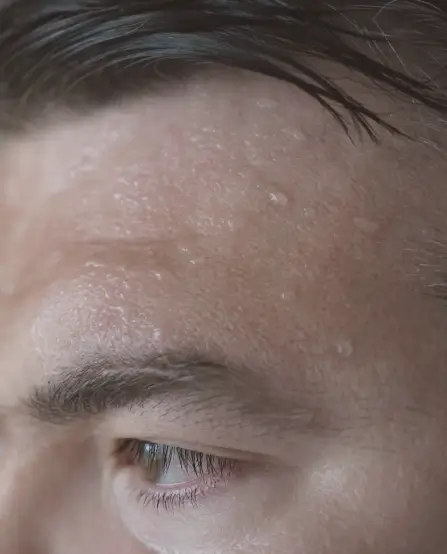
Facial sweating most often starts on the forehead, then the upper lip, nose and cheeks. It runs into the eyes, lifts make-up and fogs glasses, and it’s usually set off by heat, exertion or embarrassment, with flushing that can make it more visible. Sweating that starts as soon as you eat, often on one cheek, is a separate condition called gustatory sweating. It can follow surgery or injury near the salivary gland in front of the ear.
Muscle activity treatment is applied in small, evenly spaced points across the mapped sweating zone, designed to disrupt the nerve signal to the glands so they may produce less sweat. On the forehead, the sweat glands share the area with the muscle that lifts the brows, so the points are planned to protect brow movement, and the brows are checked again at your follow-up.
Which facial zones sweat, from brow to lip How your brows move when you raise them Flushing or rosacea alongside the sweating Whether sweating starts as soon as you eat How sweat affects your make-up or glasses - “Will my forehead look frozen?” The points are planned around the sweating zone to protect brow movement. Some softening of forehead lift is possible, and it’s reviewed at your follow-up.
- “Is it the same as forehead wrinkle treatment?” It’s the same treatment family, but it’s mapped to where you sweat, not to where lines form, so the pattern of points is different.
- “Can the upper lip be treated?” Yes, cautiously. The muscles that move the lip sit close by, so the area is kept small and your smile is checked first.
- “Will it help my flushing?” No. Flushing comes from blood vessels widening, not from sweat glands, so it’s assessed separately.
- Less sweat running into your eyes or glasses
- Make-up may stay put for longer each day
- Possible softening of forehead movement
- Repeat visits as the nerve signal returns
- Points are spaced to protect brow movement
- Upper lip points are kept to a minimum
- Flushing and rosacea are assessed separately
- Sweating while eating is assessed on its own
- Sweat dripping from the forehead at rest
- Make-up that slides off by mid-morning
- Glasses that fog up or slip from sweat
The scalp carries a dense supply of eccrine glands, especially along the front hairline and at the crown. When they overwork, sweat mixes with scalp oil, so hair can look wet or greasy within hours of washing, styles drop, and sweat runs from the hairline down the forehead and temples. Scalp sweating often comes with facial sweating, because the two share a nerve supply.
The hair is parted into rows, and muscle activity treatment is applied in small points across the mapped zone, most often the front hairline, temples and crown. It’s designed to disrupt the nerve signal so the glands may produce less sweat. Along the front hairline, points are kept away from the muscle that lifts the brows.
Whether sweat starts at the hairline or crown How soon your hair looks wet after washing Sweat running onto the forehead or neck Any scalp flaking, itching or dermatitis Whether your face sweats at the same time - “Will it affect my hair growth?” Treatment works on the nerve signal to the sweat glands, and it isn’t expected to affect the follicles or how your hair grows.
- “Why does my hair look greasy, not sweaty?” Sweat mixes with the oil on your scalp, so heavy sweating can make freshly washed hair look greasy within hours.
- “Is the scalp more painful than other areas?” The front hairline is the most sensitive part. You’ll feel a series of small pricks, and comfort options are discussed first.
- “Can I colour my hair around treatment?” Colour is best done before your visit, or a few days after once the scalp has settled. Your nurse gives you the timing.
- Hair may stay dry for longer after washing
- Less sweat running down onto your forehead
- Mild tenderness across the scalp for a day
- Further visits as the effect fades over time
- Hair is parted in rows to reach the scalp
- Front hairline points avoid the brow muscle
- Scalp dermatitis is settled before treatment
- Hair colouring is timed around your visit
- Hair that looks wet within hours of washing
- Sweat that runs down from the front hairline
- Scalp sweating that comes with facial sweat
Your Sweating Scored at Every Visit
Sweat is hard to judge from one day to the next, because heat, stress and what you’re wearing all change it. At your first visit, you rate how much sweating gets in the way of daily life on a four-point scale used in hyperhidrosis research, and each area is mapped. The same score and map are repeated at every review, so change is measured against where you started. There’s no obligation to go ahead.
From Sweat Assessment to Review
Heavy sweating can be a sign of another condition, so screening looks for secondary hyperhidrosis first: night sweats, weight loss, a racing heart, new medicines, and sweating that started in adulthood or covers the whole body. Any nerve or muscle condition is checked too, as it can rule out muscle activity treatment.

What we cover in your consultation
MEDICAL HISTORY SCREENING
night sweats, weight change and new medicines
SWEAT HISTORY
when it started, family history and sleep
AREA MAPPING
underarms, face and scalp mapped zone by zone
SEVERITY SCORE
how much sweating limits your daily life
TRIGGER REVIEW
heat, stress, food and exercise patterns
YOUR PLAN
one area or several, with follow-up reviews
Muscle activity treatment is usually a single appointment per area, repeated as the effect wears off, while Fotona and Morpheus8 for the underarms are booked as a course of sessions.
Before Your Appointment
WHAT TO BRING & KNOWSweat is easiest to map on bare skin, so the treated area needs to be free of antiperspirant and product on the day. A record of when and where you sweat over the week before gives your nurse more to go on than a single visit.
Do not use antiperspirant or deodorant that day
Keep a week’s diary of sweating and triggers
Wash hair without products for scalp treatment
Bring a list of all medicines and supplements
During Treatment
WHAT TO EXPECTYour nurse marks the mapped sweating zone on your skin, then treats it in a grid of small points, one area at a time. Numbing cream can be applied first.
The sweating zone marked out on your skin
Treatment points spaced in an even grid
Hair parted in rows for scalp treatment
Brow movement checked for forehead points
Aftercare & Follow-Up
WHAT HAPPENS NEXTThe change in sweating usually shows over one to two weeks, as the nerve signal to the glands eases. For the first day, heat and friction on the treated area are kept to a minimum.
No gym, sauna or hot yoga for the first day
Avoid rubbing or massaging the treated area
Restart antiperspirant when your nurse advises
Note any patches that still sweat for review
Treatment Is a Process, Not a Single Decision
Primary hyperhidrosis is a long-term condition. It usually starts in childhood or the teens and rarely fades on its own, so treatment is planned as a cycle of treatment, review and repeat visits.
A study of 25 people with severe underarm sweating treated one underarm with microneedle radiofrequency and left the other untreated for comparison, scoring both sides on a four-point severity scale. A year later, the treated side averaged 2.5 against 3.4 on the untreated side. Just over 40% had no relapse at one year, while just under half found the sweating returning, more often in people with a higher body weight.
That’s why every review is measured against your first score, and why repeat visits are part of the plan from the start, whichever option suits your sweating.
CLIENT REVIEWS
What our clients say


Explore More Treatment Options
Sweat glands share the skin with other structures. On the scalp they sit among the hair follicles, the skin just below the underarm loosens along the upper arm, and the same muscle activity treatment used for sweating also treats the neck muscle that pulls into vertical bands.
Scalp Microneedling with Exosomes
Needling and serum around the follicles of a thinning scalp
learn more
Wrinkle Treatments
Muscle activity treatment for forehead and frown lines

Lumecca IPL
Pulsed light for flushing, redness and visible vessels

PicoSure
Picosecond laser for darkened patches in the underarm

PRP Treatment
Platelets from your own blood applied to a thinning scalp

Exosomes Treatment
A synthetic exosome serum designed to support skin repair
3 accessible clinic locations across Melbourne
All locations
Camberwell
1172 Toorak Rd, Camberwell VIC 3124, Australia
+61 477 441 340 Book an in-clinic consultationMoonee Ponds
30-32 Holmes Rd, Moonee Ponds VIC 3039, Australia
+61 477 441 340 Book an in-clinic consultationHave Questions? Your Consultation Is a Good Place to Start.
Frequently Asked Questions about Hyperhidrosis Treatment Melbourne
SAFETY & SUITABILITY
What side effects can each area have? 
Can I be treated if my medication makes me sweat?
Who shouldn’t have hyperhidrosis treatment?
RESULTS & TIMELINE
How long before the sweating returns?
Will laser in the underarms remove hair too?
How far ahead of summer or an event should I book?
AFTERCARE & LOGISTICS
When can I shave or wax my underarms again?
Can I wear fitted tops or a bra straight after?
Is a price listed for hyperhidrosis treatment?
WHERE TO START
Should I see my GP before booking?
Should I try a clinical antiperspirant first?
MYTHS, WORRIES & 'WHAT IF'
Will my sweating come back worse when treatment wears off?
Is heavy sweating caused by anxiety?
Will drinking less water reduce sweating?
COMPARISON
Muscle activity treatment vs sweat gland surgery: what’s the difference?
Send an Enquiry
Have a question or want to learn more? We'd love to hear from you.
