
Scalp Microneedling with Exosomes Melbourne
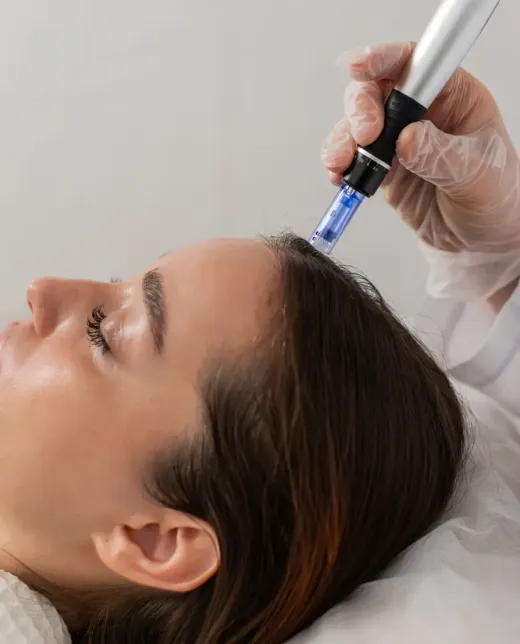
For Thinning Hair While the Follicles Are Still ActiveEach hair grows from a follicle in the skin of the scalp. In pattern hair loss, the follicles shrink a little with each growth cycle and produce finer, shorter hairs, until some stop growing altogether. Scalp microneedling uses a pen device to make fine channels through the scalp skin around those follicles, triggering the skin’s repair response. A synthetic exosome serum is applied while the channels are still open, designed to carry growth signals to the follicles. Treatment works on follicles still producing hair, but it can’t restart a follicle that has stopped.
Your AHPRA-registered nurse parts your hair in several places across the top of your head and compares the density with the back, where hair is rarely affected by pattern loss. A gentle pull on a small section shows whether more hairs than usual are in the shedding phase. Treatment is available at our Moonee Ponds, Brighton and Camberwell clinics.
2,050+
FIVE-STAR REVIEWS
ACROSS ALL MELBOURNE SITES50,000+
TREATMENTS PERFORMED
24/7
Real person chat
3
MELBOURNE CLINICS
Understanding Hair Thinning
Hair grows in cycles. Each follicle spends two to six years growing a hair, a few weeks winding down, then about three months resting before the hair falls out and a new one starts. Around 85 to 90% of follicles are growing at any one time, which is why losing 50 to 100 hairs a day is normal. Thinning starts when that balance shifts, and what shifts it depends on:

GENETICS
follicles that shrink when exposed to DHT
AGE
follicles spending fewer years in growth
IRON AND THYROID
low levels that slow or interrupt growth
SCALP CONDITION
oil, flaking or itch around the follicles
Genetics and age decide how far pattern loss has progressed and how many follicles are still active. Low iron or an under-active thyroid can continue to cause hair thinning regardless of what treatments have been performed, so blood tests through your GP come first. An inflamed or flaky scalp is settled before any needling, because broken, irritated skin heals poorly around the channels.
Scalp Microneedling with Exosomes by Thinning Pattern
A course typically runs three to six sessions, four weeks apart, and single sessions are also available. Hair grows about a centimetre a month, so new growth from the root usually takes three to six months to show as visible density, and that’s when progress is reviewed.

Follicles at the temples and along the front hairline are often the most sensitive to DHT, so pattern loss commonly starts there. In men the hairline tends to move back at both temples first, forming an M shape. As each follicle shrinks, the thick hairs along the edge are replaced by fine, soft ones that let the scalp show through, and the hairline starts to look see-through before it moves.
Needling covers the hairline and temples in a band, with shorter needle settings because the skin over the front of the scalp is thinner. The synthetic exosome serum goes into the open channels, designed to support the follicles making those fine hairs so they may grow thicker over the course. The aim is a denser edge. Moving a hairline forward takes a hair transplant.
 Recession at each temple and the front edge Fine, fuzzy hairs along the front hairline How far the hairline has moved in recent years Family history of hair loss on both sides How sensitive the skin feels across the front
- “Can I still colour my hair?” Dye sits right on the skin along the hairline, so colour is done before your session or once the scalp has healed, usually after a week or two.
- “Will it bring my hairline forward?” It’s designed to thicken the fine hairs along the edge. The line itself stays where it is, and moving it forward takes surgery.
- “Is the front more painful?” The skin over the temples is thinner, so it can feel sharper there. Numbing cream goes on first and shorter needle settings are used.
- “Will people be able to tell?” The hairline may look pink with pinpoint marks for a day or two. Hair styled forward usually covers it.
- Fine hairs at the hairline may grow thicker
- The edge may look softer and less see-through
- Pinkness along the hairline for a day or two
- Mild tenderness across the temples afterwards
- Thinner skin at the front gets shorter needles
- Mild swelling can settle onto the forehead
- Sunburn along the hairline delays treatment
- Tight hats and helmets are avoided for a day
- Early recession at the temples or hairline
- Fine hairs that make the hairline see-through
- Those not yet ready to consider hair surgery
Hair at the crown grows outward in a spiral from a central point called the whorl. Pattern thinning there starts as a slight widening of the whorl, then a coin-sized patch where the scalp shows through, most noticeable under overhead light, in photos taken from above or when the hair is wet. The crown sits out of view in a mirror, so many people only find out when someone mentions it.
Needling covers the thinned patch and the ring of hair around it, where follicles are often starting to shrink next. The skin at the crown is thicker than at the front, so longer needle settings can be used. The synthetic exosome serum is applied straight after, designed to support the follicles around the whorl, and hair there may look thicker as the course goes on, with less scalp showing under light.
Width of the thinned area around the whorl Hair thickness at the crown and at the back How the crown looks under overhead light Whether the thinning is spreading forward Photos showing how the crown has changed - “Could it just be my natural whorl?” Some people have a wide or double whorl that can look like thinning. Comparing hair thickness at the crown with the back of the head shows the difference.
- “Will the patch keep spreading?” Pattern thinning at the crown can widen over time and may eventually meet thinning at the front. Your nurse measures the patch so any change is tracked.
- “Is the crown easier than the hairline?” The skin there is thicker, so most people find it more comfortable. Numbing cream is applied first either way.
- “How can I check it at home?” A phone photo from directly above, taken in the same spot and light each month, shows the crown more clearly than a mirror.
- Hair around the whorl may look thicker
- Less scalp may show under overhead light
- Redness at the crown usually hides under hair
- Tenderness on the crown for a day or so
- Needling extends past the visible patch
- Thicker skin here allows longer settings
- Lying on the crown may feel tender at first
- A natural double whorl is ruled out first
- A widening patch of scalp at the crown
- Thinning first noticed in photos from above
- Crowns that show through under bright light
Diffuse thinning spreads across the top of the scalp while the front hairline usually keeps its shape. It’s the most common pattern in women. Follicles across the area shrink at different rates, so thick and fine hairs grow side by side, and the part widens most towards the front, often noticed first as a thinner ponytail. It tends to become more noticeable around menopause, as falling oestrogen leaves follicles more sensitive to DHT.
The hair is parted into rows and the whole top of the scalp is needled, from the hairline back to the crown. The synthetic exosome serum follows straight after, designed to support follicles across the area so finer hairs may grow thicker and the part may look narrower over the course. For those who’d rather explore alternative treatments, PRP applies platelets directly to the scalp.
Part width at the front compared with the back A mix of thick and fine hairs across the top Whether the front hairline has held its shape Ponytail thickness compared with years ago Recent hormonal changes, including menopause - “Is this the same as shedding?” Diffuse thinning is hair growing finer over time, often without much extra hair fall. Shedding is hair falling from the root in larger amounts than usual.
- “Can men have diffuse thinning too?” Yes. Some men thin evenly across the top without a receding hairline or a bald crown, and the whole area is treated the same way.
- “Can I keep wearing my hair up?” Tight ponytails and buns pull on follicles along the part and hairline, so looser styles are better while you’re having treatment.
- “Will redness show along my part?” The part may look pink for a day or two. Parting your hair on the other side usually hides it.
- Hair across the top may look and feel fuller
- The part may look narrower over the course
- Your ponytail may feel thicker over time
- Pinkness along the part for a day or two
- The whole top of the scalp is treated each time
- Hair is parted into rows before needling
- Tight styles are best avoided between sessions
- Hormonal changes may affect the response
- A part that has widened towards the front
- Thinning across the top with the hairline intact
- Ponytails that feel thinner than they used to
Telogen effluvium is shedding set off by a shock to the body, such as childbirth, a high fever, surgery, a crash diet or a period of severe stress. The shock pushes many growing follicles into the resting phase at once, and about three months later their hairs fall together, coming out in handfuls in the shower or the brush. Each shed hair has a small white bulb at the root, the loss is spread evenly over the scalp, and the follicles themselves stay healthy.
Shedding usually eases on its own within about six months once the trigger has passed, so the trigger is identified and dealt with first. Treatment is timed for when the shedding slows and the follicles move back into growth. Needling and the synthetic exosome serum are then designed to support the new hairs coming through, which may help density build back sooner.
When the shedding started and what came before Whether shed hairs have a white bulb at the root How evenly the loss is spread across the scalp Whether the shedding is easing or still rising Short new hairs growing back along the part - “Will I go bald?” Telogen effluvium thins hair evenly and rarely leaves bald patches. The follicles stay healthy, so hair usually grows back once the shedding stops.
- “Should I wash my hair less?” Washing only removes hairs that have already come loose from the follicle. Washing less means more of them come out at once next time.
- “What if it lasts longer than six months?” Shedding that keeps going is called chronic telogen effluvium. It’s reviewed again, and your GP may look for another cause.
- “When will I see it growing back?” Short, upright new hairs along the part and hairline are often the first sign, appearing a few months after the shedding slows.
- Shedding usually eases once the trigger passes
- New hairs may come through along the part
- Density may build back as regrowth continues
- Pinkness across the scalp for a day or two
- Treatment waits until the shedding slows down
- Crash diets and low protein can restart shedding
- Stopping the contraceptive pill can trigger it
- Breastfeeding is discussed during your consultation
- Shedding that started after illness or birth
- Hair coming out in handfuls in the shower
- Hair slow to fill back in once shedding eases
Patterns Often Overlap
Men often thin at the temples and crown at the same time, and a bout of shedding can reveal pattern thinning that had been building unnoticed underneath. Your nurse checks the hairline, crown and part in one visit, and every pattern you have is treated in the same session. There’s no obligation to go ahead.
From Scalp Assessment to Review
Hair loss often traces back to something that happened months earlier, so screening covers the past six months: illness, surgery, childbirth, diet changes and any medication you’ve started or stopped, along with blood test results if you have them.

What we cover in your consultation
MEDICAL HISTORY SCREENING
recent illness, surgery, childbirth and medicines
BLOOD RESULTS
iron and thyroid levels from your recent GP tests
PATTERN MAPPING
hairline, crown and part compared with the back
HAIR HABITS
tight styles, colouring, heat and washing habits
BASELINE PHOTOS
the top and front photographed for each review
YOUR PLAN
a single session or a course of three to six sessions
Each session takes about an hour, with numbing cream left on the scalp for 20 to 30 minutes before needling starts.
Before Your Appointment
WHAT TO BRING & KNOWOil, dry shampoo and styling products sit on the scalp and can be pushed into the channels, so the scalp needs to be freshly washed and bare on the day. A top you can take off without pulling it over your head saves catching the treated scalp on the way home.
Wash your hair that morning, with no products
Leave out dry shampoo, oils and hairspray
Pause scalp scrubs and exfoliating shampoos
Wear a top that buttons or zips at the front
During Treatment
WHAT TO EXPECTYour nurse parts the hair section by section and works across each treated area, then massages the synthetic exosome serum into the scalp while the channels are still open. The serum stays in your hair until the next day.
A new, sterile needle cartridge each session
A tapping or scratching feel across the scalp
Pinpoint bleeding is wiped away as you go
Hair may look damp and flat from the serum
Aftercare & Follow-Up
WHAT HAPPENS NEXTLeaving the serum in overnight gives it time on the scalp while the channels close, which usually takes about a day. Redness across the scalp tends to fade within one to three days.
Wash the next day with a gentle shampoo
No styling products or hot tools for 48 hours
Sleep on a clean pillowcase the first night
Skip gyms, swimming and saunas for 48 hours
Treatment Is a Process, Not a Single Decision
Pattern hair loss builds over decades. Most people notice it at a single moment, often a wider part or a thinner crown in a photo, but by then the change has usually been under way for years.

A study of adults in Maryborough, Victoria examined hair loss across every age group. Thinning at the temples was found in 98.6% of men and 64.4% of women, and by age 80, thinning across the top of the scalp affected 73.5% of men and 57% of women. None of the children examined, aged five to nine, showed either.
For most people, then, thinning is the expected direction, so treatment is planned as a course to build density, followed by maintenance sessions to help hold it. Your consultation records where your hair sits now, and each review is measured against that starting point.
CLIENT REVIEWS
What our clients say


Explore More Treatment Options
The scalp is the same skin as the face, with far more follicles and oil glands packed into it. The repair that needling triggers around hair follicles works the same way in facial skin, where it builds collagen, and facial skin can also be resurfaced with laser or renewed with acids.
Skin Microneedling with Exosomes
The same pen and serum, used on the face for texture, tone and lines
Learn moreAcne Scar Revision with Fotona
Laser modes matched to each type of acne scar, with RF for deep scars
Learn more
Morpheus8
Radiofrequency microneedling that firms loosening skin on the face

Fotona 5D
A layered Fotona laser protocol for firmness and fine lines on the face

PicoSure
Picosecond laser that breaks up sun spots on the forehead and temples
Lumecca IPL
Pulsed light for redness and sun damage across the face and chest

Rejuran
Polynucleotides used to support repair in thin, sun-damaged skin
3 accessible clinic locations across Melbourne
All locations
Camberwell
1172 Toorak Rd, Camberwell VIC 3124, Australia
+61 477 441 340 Book an in-clinic consultationMoonee Ponds
30-32 Holmes Rd, Moonee Ponds VIC 3039, Australia
+61 477 441 340 Book an in-clinic consultationHave Questions? Your Consultation Is a Good Place to Start.
Frequently Asked Questions
SAFETY & SUITABILITY
Are scalp microneedling with exosomes treatments safe? 
Who is a good candidate and who should avoid it?
What are the possible side effects?
RESULTS & TIMELINE
How long does it take to see changes?
Can one scalp microneedling with exosome treatment make a difference?
Are results permanent?
AFTERCARE & LOGISTICS
Is there downtime after scalp microneedling?
Can I exercise after treatment?
Can I get a haircut or a fade between sessions?
CHOICE ARCHITECTURE
Can I have it before or after a hair transplant?
How far ahead should I start before an event?
FEAR-ADDRESSING
Will microneedling make my hair fall out?
I’m nervous about needles. Will I see them?
Does it hurt?
COMPARISON
What’s the difference between Scalp microneedling with exosomes and PRP?
Send an Enquiry
Have a question or want to learn more? We'd love to hear from you.