Disclaimer: This blog is intended for general educational purposes only and does not constitute medical advice or advertising of regulated health services. Any references to treatments or procedures are provided for informational awareness and should not be interpreted as recommendations or promotions. For personalised advice, please consult a qualified healthcare professional.
Key Takeaways:
- A nose thread lift procedure runs in stages: preparation, a suitability check, thread placement under local anaesthetic, and a recovery period, typically taking around 90 minutes on the day.
- Local anaesthetic means you shouldn’t feel the placement itself as pain, most people notice pressure and movement rather than anything sharp.
- Swelling, tenderness and minor bruising are normal for the first few days and most visible swelling eases over one to two weeks, with a follow-up usually scheduled two to four weeks later.
A nose thread lift procedure typically takes less than two hours, but what happens before, during, and after the treatment can influence both your experience and your recovery. Understanding the process beforehand helps you arrive prepared, know what’s considered normal as you heal, and avoid common mistakes that may affect the early result.
Preparing for your nose thread procedure
At least 7 days before, pause any blood-thinning medications or supplements, and 48 hours before your appointment, avoid consuming alcohol.. Alcohol, Fish oil, vitamin E, ibuprofen and aspirin all thin the blood and raise the chance of bruising around the nose. If you are taking prescribed blood-thinners, consult your primary care doctor before stopping them.
On the day of, come to your appointment with a clean, makeup-free face to prevent infection at the tiny entry points. Drink plenty of water in the lead-up to your appointment to keep your skin plump and healthy and eat a light meal beforehand to prevent lightheadedness while numbing agents are applied. Foods high in Vitamin K (like spinach and broccoli) can help your blood clot more effectively and reduce bruising.
Wear something comfortable you don’t mind lying back in and consider loose, comfortable clothing you don’t pull over your head afterwards. None of this is difficult, but it does affect how the day goes and how the area settles afterwards.
The nose thread consultation
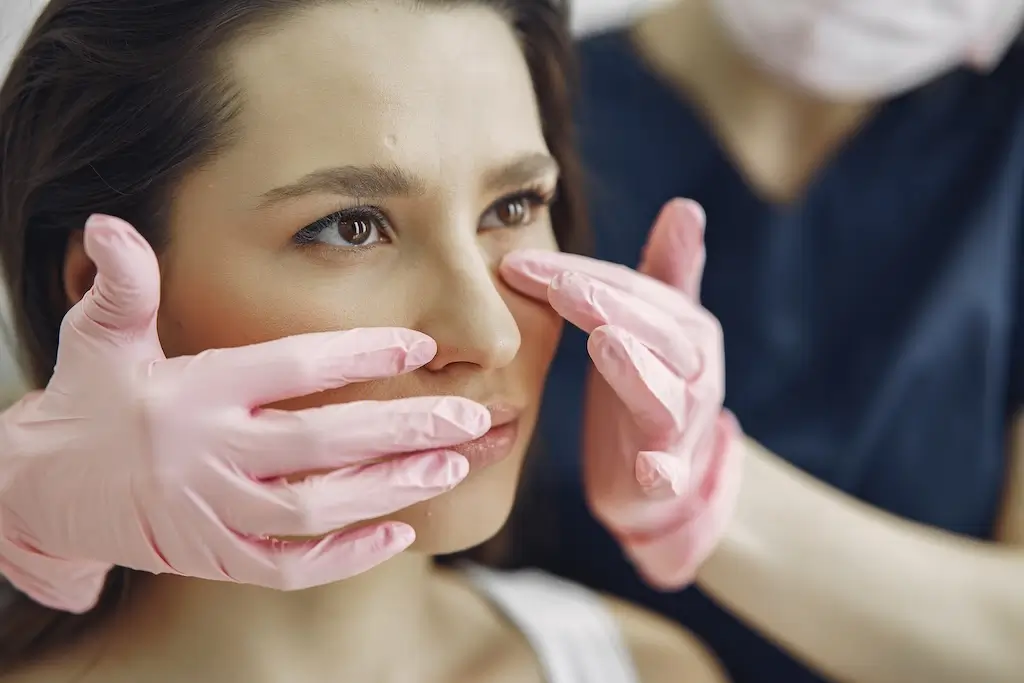
Before any threads are placed, your nurse has to confirm the treatment is appropriate for you. This isn’t a formality. It’s a clinical and legal requirement, and it happens at every appointment regardless of how straightforward your case seems.
The assessment covers your medical history, current medications, and any conditions that affect healing or bleeding. Some things rule a thread lift out entirely: pregnancy, breastfeeding, an active skin infection over the nose, or autoimmune and connective-tissue conditions. Others don’t rule it out but change how the treatment is approached, such as a tendency to keloid scarring (a thick, raised, and overgrown scar) or a history of previous work on the nose.
You’ll also go through informed consent: what the procedure involves, what it can and can’t do for your nose, and the risks specific to your procedure. This is your point to ask anything you’re still unsure about. Consent isn’t a form to sign at the end, it’s the conversation that confirms you understand what you’re agreeing to before it begins.
If the assessment shows a thread lift isn’t right for you, your nurse will tell you and explain why. Being turned down for treatment is the screening working as it should, not a failure of the appointment.
What to expect during your procedure
Once you’re checked in and any final questions are answered, your AHPRA registered nurse cleans the nose and surrounding skin thoroughly to reduce the risk of infection at the entry points.
Next comes mapping. this is where we mark the entry points and the path each thread will follow, working to the plan agreed during your assessment. This is where the treatment is tailored to your nose, the position of each thread determines the support it gives, so the marking stage is done carefully.
The area is then numbed with local anaesthetic. This is usually the only part you’ll feel to any real degree, a brief sting as it goes in, after which the nose becomes numb and you shouldn’t feel the placement itself. Your nurse will wait for the anaesthetic to take full effect before going further.
With the area numb, the threads are placed. Each PDO thread is introduced through a small entry point using a fine needle or cannula, positioned along the mapped path, and set in place. You may feel light pressure or movement as this happens. Depending on how many threads are being placed and the areas being treated, this takes anywhere from a few minutes to an hour.
Once all the threads are in, the nurse checks the result: symmetry, the position of each thread, and how the nose sits. Small adjustments can be made at this stage if needed. When you and the nurse are happy, the entry points are cleaned and you’re given your aftercare guidance before heading home the same day. Typically procedures run about 90 minutes from start to finish.
Your Next Step
Choosing whether nose threads are right for you is a personal
decision. If you’d like to explore your options, understand what may suit your features,
or simply ask questions, our medical professionals are here to guide you with clarity and care.
A $100 deposit is required to secure an appointment. Full amount is completely redeemable or refundable if you decide not to go ahead with the treatment.
Recovery and aftercare
The first few days are when swelling is at its peak. Your nose will feel firm, stiff and slightly larger than expected, and you may notice tenderness at the entry points, a mild dull ache, and minor bruising on or around the nose. Small crusts can form at the entry points. This is the normal early response and it settles as the days pass.
Most of the visible swelling eases over the first one to two weeks, and the nose gradually starts to feel more like your own again. The small entry-point marks, usually only 1 to 2mm, tend to resolve within a few days.
Aftercare in this period is mostly about protecting the threads while the tissue settles around them: keeping your head elevated, being gentle with the nose, and avoiding pressure on the bridge, which is why glasses are restricted early on. A follow-up is usually scheduled two to four weeks later, once the swelling has settled enough to assess how the nose has responded.
Full aftercare instructions, including what to do and avoid day by day, will be provided after your procedure.
Professional standards at Luxe Lips
At Luxe Lips, a cosmetic clinic in Melbourne, our care is grounded in medical ethics and quiet clinical responsibility. Every treatment pathway is approached as a medical process, with established health protocols and safety guiding each step.
Across our clinics in Moonee Ponds, Camberwell, and Brighton, our medical professionals carry out a thorough screening process for every person. For those considering nose thread lifts, this includes reviewing medical history, assessing anatomical suitability, and considering psychological readiness. In line with local guidelines, this evaluation helps determine whether a proposed plan aligns with your health.
Medical professionals proceed only when a treatment is clinically appropriate. If your underlying concern, the condition of the surrounding skin, or your broader health profile means nose thread lifts aren’t the right fit, we will explain why and discuss what that means for you. The focus is always on clear information and maintaining a clinical environment where safety and ethical standards come first.
Because responses and circumstances vary, a consultation is required to determine suitability before nose thread lifts are considered.
Note: Individual responses vary. A consultation with a qualified professional is required to determine the suitability of any treatment for your specific needs.
Questions we’re often asked about nose thread procedures
There’s no set number, because it depends on your nose and what’s being supported. The bridge, the tip, or both being treated, the degree of support needed, and the thickness of your skin all influence the count. Thicker or more heavily built noses generally need more threads to hold a result, while finer noses may need fewer.
The type of thread matters too, since different threads do different jobs within the same treatment. This is why a flat “X threads for a nose” figure tends to mislead. The number appropriate for your nose is worked out from your anatomy and the plan agreed beforehand, which a medical professional can establish once your nose has been assessed.
Most people are back to everyday activities quickly, often the same day or the next, but “downtime” depends on how you define it. You can generally function normally right away. Looking fully settled is a slower matter, since swelling, minor bruising and tenderness around the nose are typical for the first few days.
If you’d rather not be seen while the nose is visibly swollen, it’s worth allowing a few days, and around one to two weeks for most visible swelling to ease. Strenuous exercise and anything that presses on the nose are best paused early on. How much downtime suits your routine and plans is something a medical professional can walk through beforehand.
Once the local anaesthetic has taken full effect, you shouldn’t feel the placement as pain. What most people notice instead is pressure and movement, a sensation of something being worked within the nose rather than anything sharp. It can feel unusual, particularly the pressure as each thread is set into position, but it’s generally described as strange more than distressing.
The one part you’re likely to feel properly is the anaesthetic going in at the start, usually a brief sting before the area numbs. After that, sensation is dulled for the placement itself. If you do feel anything sharp during placement, it’s worth saying so, since more anaesthetic can be given.
The threads are positioned through very small entry points, usually around one to two millimetres, rather than through any cut or incision. In the first few days these can look like tiny spots and may have a small crust as they heal, which is a normal part of the early recovery.
For most people these marks settle and become hard to see within a few days, leaving no lasting hole. How any skin heals varies from person to person, so a small mark taking a little longer to fade isn’t unusual. What’s likely for your skin, and how to care for the entry points as they settle, is something a medical professional can outline for you.
The follow-up, usually a couple of weeks to a month after treatment, is where the nose is reviewed once the early swelling has settled enough to see how it’s responded. By that point the immediate swelling has largely eased, so it’s a more reliable moment to assess the shape than the first few days.
It’s also a chance to check the entry points have healed well, talk through how the recovery has gone, and raise anything you’ve noticed since. If any small refinement is worth considering, this is where that conversation happens. What your own follow-up will cover is something a medical professional can discuss when your plan is set.