Key takeaways
- Creatine hasn’t been shown to cause hair loss in men. The fear traces to a single 2009 study that measured a rise in DHT, not hair loss, and has never been replicated. A 2025 trial measuring hair directly found no difference between creatine and placebo.
- The direct evidence is reassuring but thin. The strongest study ran only 12 weeks in healthy young men and didn’t screen for genetic hair-loss risk, so it can’t speak to long-term use or men already prone to thinning.
- The reassuring research isn’t independent. The 2021 and 2025 studies share authors with disclosed creatine-industry ties and ran in a journal the lead author heads. The findings may well be valid, but independent replication doesn’t yet exist.
You’ve started taking creatine as part of your training, then come across the claim that it can increase DHT and contribute to hair loss. Understandably, you might wonder whether the two are connected.
In this post we’ll break down what the science actually says, where it doesn’t fit the social media narrative, and whether or not the science is credible to begin with.
Why is creatine linked to hair loss?
It all started with a small 2009 study involving 20 college-aged male rugby players.
The participants took creatine for three weeks, beginning with a seven-day loading phase followed by a lower maintenance dose. Researchers measured testosterone and dihydrotestosterone, or DHT.
The results found that DHT increased by 56% after 7 days of creatine loading, while testosterone didn’t significantly change.
That finding attracted attention because DHT is associated with male pattern hair loss.
There’s an important detail, though: the researchers weren’t studying hair loss. Hair shedding, density and follicle changes weren’t measured, the study had baseline group discrepancies, and it has never been successfully replicated since.
Does creatine actually cause hair loss in men?
This is where it helps to separate what we know from what has been assumed.
The theory essentially goes: Creatine may increase DHT → DHT is involved in male pattern hair loss → creatine causes hair loss.
The problem is that the final step doesn’t automatically follow from the first two.
A 2021 review of creatine research noted that the DHT finding from the 2009 study hadn’t been replicated and that the evidence didn’t support the conclusion that creatine causes hair loss.
Then in a 2025 randomised controlled trial, 45 resistance-trained men aged 18 to 40 were assigned either 5 g of creatine monohydrate or a placebo each day for 12 weeks.
Researchers didn’t just measure hormones. They also assessed hair density, follicular units, hair thickness and other measures of hair growth.
Among the 38 participants who completed the study, there were no significant differences between the creatine and placebo groups in DHT or any of the measured hair outcomes.
It still doesn’t answer every possible question. The study lasted 12 weeks and involved healthy, resistance-trained men. Longer-term research and studies across different populations could add to their findings.
Is the science regarding creatine and hair loss credible?
This is where it gets a little murky.
All of the studies are real. As mentioned, there were issues with the initial 2009 study across many variables.
But that doesn’t make the 2021 and 2025 studies definitive. On the surface they look like independent confirmation of each other. They aren’t.
Jose Antonio and Scott C. Forbes appear as authors on both. Both papers were published in the Journal of the International Society of Sports Nutrition, the journal of the society Antonio runs as CEO, and a society that takes sponsorship from creatine companies.
Their own competing-interest statements spell out the ties: Antonio as ISSN CEO and a scientific advisor to creatine brands including Creapure and Bear Balanced; Forbes as a scientific advisor to Bear Balanced and a recipient of creatine donations from Creapure. A third author on the 2025 trial, Grant Tinsley, discloses research funding from sports-nutrition companies and owns a consultancy that advises supplement manufacturers.
A conflict of interest does not automatically equal bad data. Jose Antonio and Scott Forbes are legitimate, highly cited researchers who have done massive amounts of good work in sports nutrition. It is highly probable that their methodology was sound and their findings are 100% accurate.
However, science relies on the appearance of absolute neutrality to build public trust. When the researchers shaping and publishing the counter-evidence are the ones with financial and institutional ties to the product, it leaves the door wide open for valid skepticism.
The truth is, we won’t know with certainty until there are more independent studies performed.
Should you stop taking creatine if you’re losing hair?
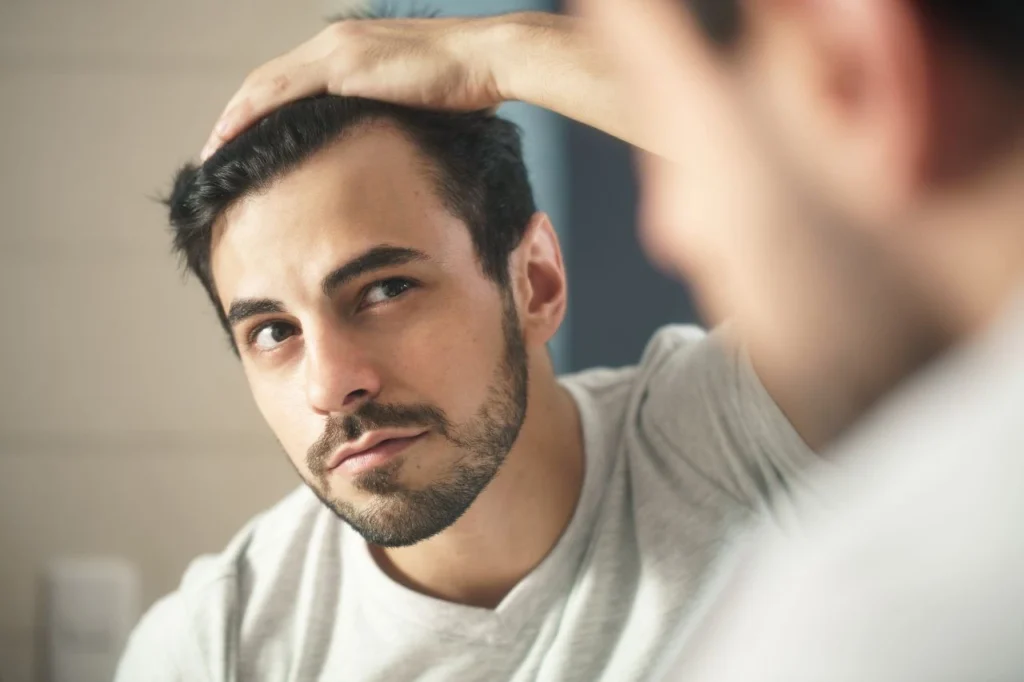
Starting creatine and then noticing more shedding can naturally make you question whether there’s a connection. Timing alone, though, isn’t enough to determine the cause.
Rather than making a decision about a supplement as a treatment for hair loss, consider what kind of change you’re experiencing.
Is your hair gradually becoming less dense? Is the hairline changing? Has shedding appeared suddenly? Are there distinct patches or changes to your scalp?
If the change is new or significant, or you have sudden shedding, bald patches, scalp pain, redness or scaling, speak with your GP or another qualified medical professional. You can also discuss any supplements or medicines you’re taking as part of that conversation.
What you can do if you’re concerned about thinning hair?
The next step depends on what kind of change you’re noticing and what may be contributing to it.
Good hair and scalp care can help reduce unnecessary damage, but it can’t prevent genetically influenced hair loss.
At that point, you may need to look into medications subscribed by your GP, transplants/plugs, or cosmetic procedures for men that may encourage hair follicles to regrow new hair.
If you’re considering treatment, a consultation with a medical professional is the required first step.
Your Next Step
Choosing whether men’s cosmetic treatments are right for you is a personal
decision. If you’d like to explore your options, understand what may suit your features,
or simply ask questions, our medical professionals are here to guide you with clarity and care.
A $100 deposit is required to secure an appointment. Full amount is completely redeemable or refundable if you decide not to go ahead with the treatment.
Professional standards at Luxe Lips
At Luxe Lips, a cosmetic clinic in Melbourne, our care is grounded in medical ethics and clinical responsibility. Every treatment pathway is approached as a medical process, with established health protocols and safety guiding each step.
Across our clinics in Moonee Ponds, Camberwell, and Brighton, our medical professionals carry out a thorough screening process for every person. For men considering cosmetic treatments, this includes reviewing medical history, assessing anatomical suitability, and considering psychological readiness. In line with local guidelines, this evaluation helps determine whether a proposed plan aligns with your health.
Medical professionals proceed only when a treatment is clinically appropriate. If your underlying concern, the condition of the surrounding skin, or your broader health profile means treatment is not the right fit, we will explain why and discuss what that means for you. The focus is always on clear information and maintaining a clinical environment where safety and ethical standards come first.
Because responses and circumstances vary, a consultation is required to determine suitability before men’s cosmetic treatments are considered.
Questions we’re often asked about creatine and hair loss
Some can. Products marketed for muscle gain sometimes contain anabolic steroids, prohormones, or undisclosed ingredients that raise androgen levels, which can accelerate thinning in men who are genetically prone to it.
Creatine monohydrate isn’t in that category. It works through energy metabolism, not hormones. The risk lies with pre-workouts and “test-boosting” blends that hide their formulas, not with well-studied single-ingredient supplements. Check labels, and be cautious with proprietary blends that don’t disclose doses.
The most common cause is male pattern hair loss, driven by genetics and sensitivity to DHT. It typically shows as a receding hairline or thinning at the crown.
Additionally, shedding is often triggered by stress, illness, rapid weight loss, nutritional deficiencies (iron, vitamin D, protein), poor sleep, and thyroid issues. This type, called telogen effluvium, is usually temporary and reverses once the trigger resolves. Sudden patchy loss warrants a medical opinion.
No. There’s no evidence that any form of creatine affects hair, and no reason to expect a difference between them.
Monohydrate is the most researched form by a wide margin, including the studies looking at DHT and hair outcomes. HCL, ethyl ester, and buffered versions differ in solubility and marketing claims, not in how they act in the body. None has been credibly shown to influence hair growth or loss.
Creatine monohydrate is well tolerated at 3–5 g per day. A few simple practices help you track how you respond.
Stick to a standard dose rather than mega-dosing, drink adequate water, and take it consistently so any changes are easier to attribute. If you have kidney concerns, discuss it with your doctor first. Note any new or persistent changes over weeks, not days, since normal fluctuations happen regardless of supplementation.
No. Across studies measuring testosterone, most show no meaningful change in total or free testosterone from creatine supplementation.
A couple of very short early trials reported small increases, but longer and better-controlled studies haven’t confirmed a real effect. Any testosterone rise you experience is far more likely to come from the resistance training itself than from the creatine. It’s a performance and recovery aid, not a hormonal one.